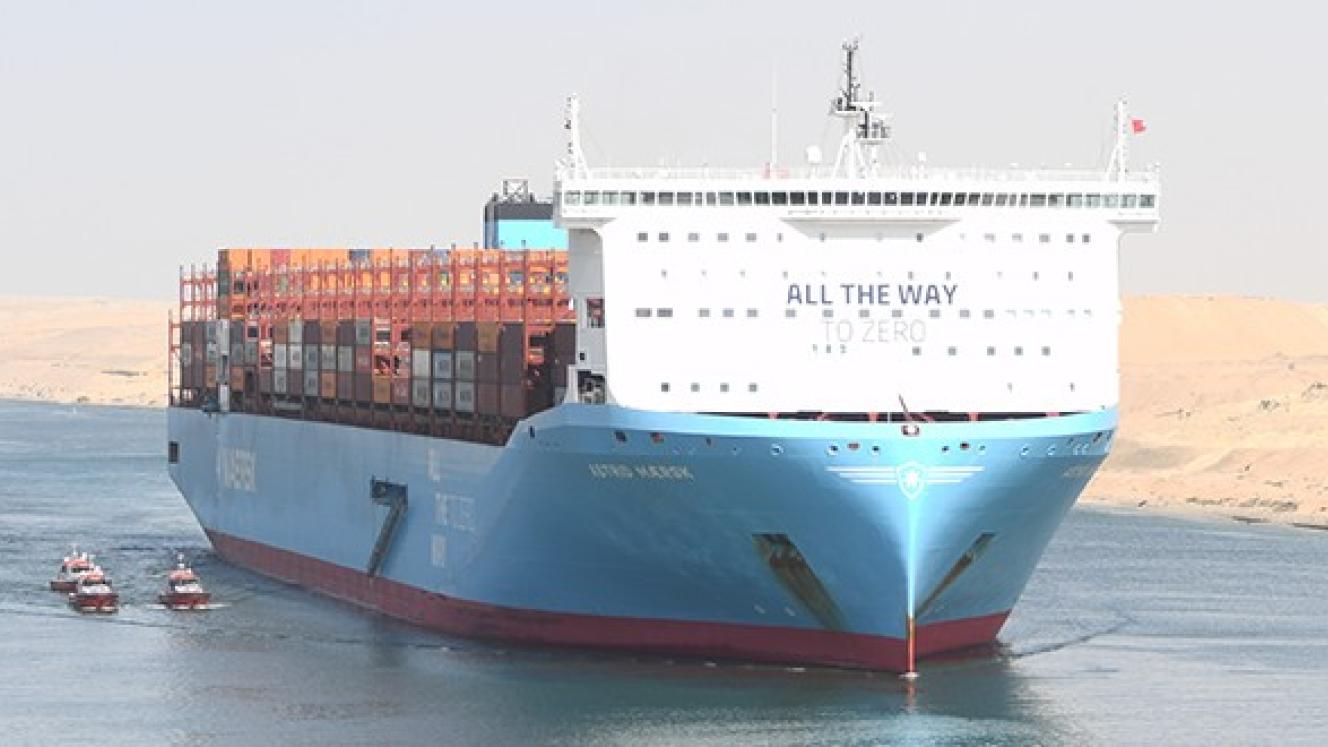
What is generally believed to be the most risk-averse container line in the industry, Danish carrier Maersk has made its intentions clear to return to Red Sea voyages by sailing the largest box ship through the Suez Canal in two years.
Adding to the significance of Tuesday’s transit of the Astrid Maersk, is that it is a Post-Suezmax, capable of carrying up to 16 000 TEU at a gross 185 000 tonnes.
The methanol-fuel vessel is 350 metres in length, has a beam of 54 metres and a draft of 14.8 metres.
At this stage, Maersk has sailed one box ship through Suez since signing the Strategic Partnership Agreement (SPA) with the Suez Canal Authority (SCA) late last year, re-commencing voyages through the Egyptian waterway with the Maersk Sebarok in December.
In January it was the Maersk Denver.
Wednesday’s transit confirms the intention of the ME-11 service, a vessel-sharing service that is part of Maersk and Hapag-Lloyd’s Gemini Cooperation, to start using the Suez once more.
The service connects the Mediterranean with India and the Middle East and, until December’s Sebarok voyage, had been rerouted around the Cape of Good Hope.
However, Gemini has notified its clients that ME-11 will henceforth sail through the Suez following its SPA with the SCA.
Authority chairman Admiral Ossama Rabiee said Maersk’s return to the Suez reaffirmed the Canal’s position as the shortest East-West route between Europe and Asia.
The SCA’s aggressive strategising around attracting business back to the Suez is bearing good fruit at this early stage of normalisation of risk in the once-fraught Red Sea.
Since embarking on market incentives for lines in 2025, 784 vessels have returned to the waterway, sailing 36.6 million tonnes of cargo through the Suez and generating revenues of USD$170.4 million for the SCA.
The Astrid Maersk benefited from a 15% toll reduction because of its size, being capable of carrying more than 130 000 tonnes, laden or not.
After the large-tonnage incentive was introduced in May, 64 vessels have made use of the offer, bringing 9.9 million tonnes of cargo back to the Suez.