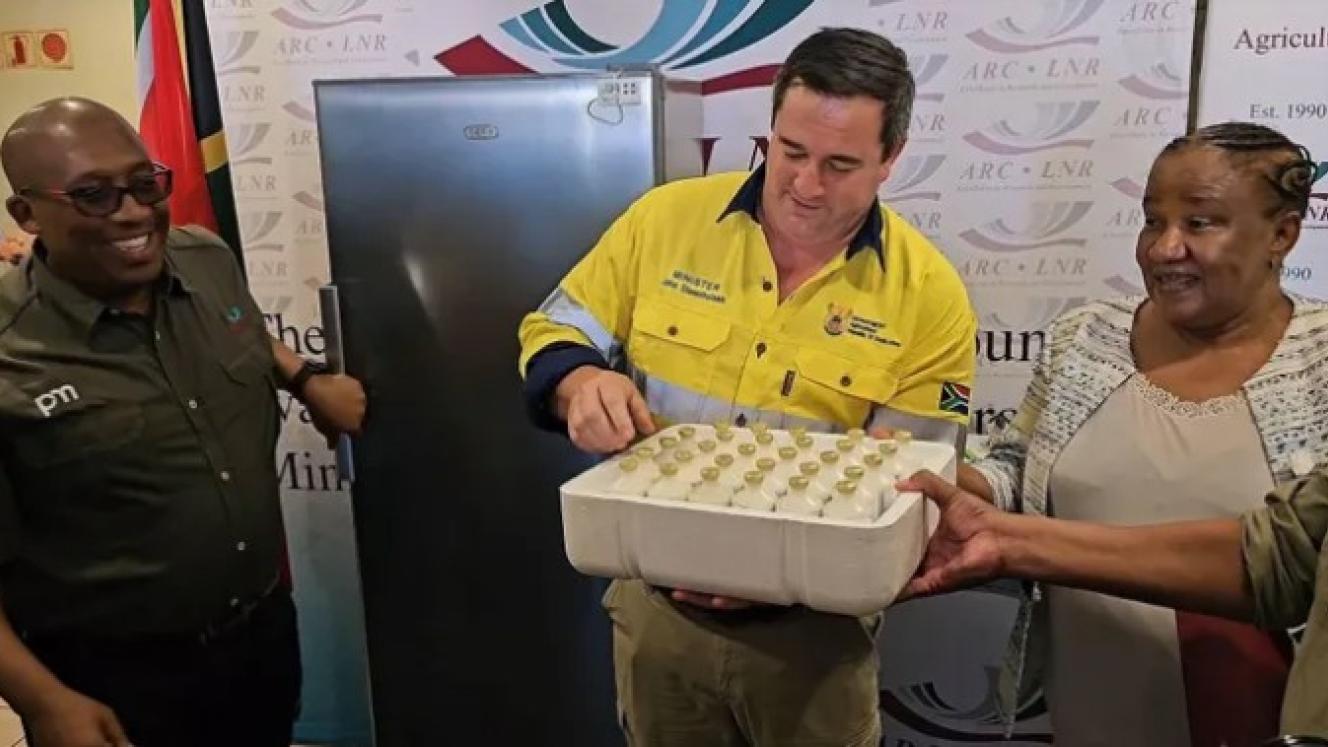
Agriculture Minister John Steenhuisen has received the first batch of Foot and Mouth Disease (FMD) vaccines from the Agricultural Research Council (ARC), marking the first time in over two decades that South Africa has produced the vaccine locally.
Steenhuisen received the inaugural batch of 12 900 doses from ARC president and CEO Dr Litha Magingxa on Friday.
The long-term goal is to achieve FMD-free status with locally produced vaccines, developed through collaboration between government, the ARC, and the Onderstepoort Biological Products (OBP).
Steenhuisen addressed farmers directly amid the steep economic impact of the latest outbreak.
“To our farmers who have watched their livelihoods disappear before their eyes, I hear you, and I feel the weight of this hardship with you. This has been a long, exhausting road, but I want you to know that help is not just coming, it is here,” he said.
“My department and I will stop at nothing to ensure this disease is completely eradicated from our farms and communities. While the path to full recovery will take time, specifically through our focused ten-year strategy, we are finally moving from defence to offence. Please do not lose faith; we are building a system that will protect your herds for generations to come.”
According to the Department of Agriculture, the 12 900 doses serve as proof of concept and have been distributed as follows: Free State (2 300), Eastern Cape (2 600), North West (2 000), Gauteng (2 000), Limpopo (2 000), and Mpumalanga (2 000).
Production will ramp up significantly, with the ARC able to supply 20 000 vaccine doses per week from March, scaling to 200 000 doses per week by 2027.
The department said it had also secured imports to ensure continuity of supply. The Botswana Vaccine Institute has supplied two million doses to date, with 700 000 more expected by end-February, and monthly deliveries of 700 000 in April, May and June.
Argentina's Biogénesis Bagó will provide one million doses soon, followed by five million in March, while Turkey's Dollvet is delivering 1.5m doses in the third week of this month, with another five million in March.
Steenhuisen said the department welcomed private sector involvement through designated agents such as Design Biologix for Biogénesis Bagó and Dunevax for Dollvet. However, his department warned against illegal imports and rejected calls for unrestricted vaccine access, citing risks and the need for centralised control to meet World Organisation for Animal Health (WOAH) requirements – no virus transmission for at least 12 months, verified through surveillance, movement controls and documented vaccination.
“In line with WOAH agreements for FMD reference laboratories, local FMD strains have been sent to the Pirbright Institute in the United Kingdom for matching against circulating viruses. Additionally, the department has finalised a memorandum to declare a National State of Disaster, which will be tabled soon in Cabinet. This will unlock emergency funding for mass vaccination across affected provinces,” the department said.
South Africa halted domestic FMD vaccine production in 2005 due to outdated technology and infrastructure that failed to meet international Good Manufacturing Practice standards.
After years of research and facility modernisation that started in 2010, the ARC has now produced this initial batch using advanced bioreactor technology. The vaccines target circulating regional strains, delivering high potency and long-lasting immunity while complying with biosafety and regulatory requirements.
In support of national efforts, Western Cape Premier Alan Winde, announced on Sunday that the province had allocated R100m from contingency funds to procure sufficient vaccine doses to protect livestock in the province.