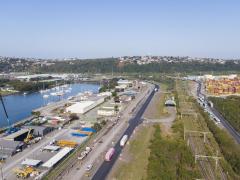
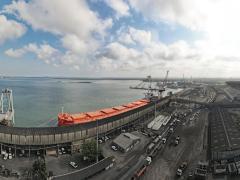
In line with its mission to oversee the regional interests of transporters in the East and Southern African region, Fesarta last month led a factfinding mission to Beitbridge in the wake of deteriorating congestion at the busy border post. While the rest of the country moved into holiday mode, FTW’s Tersia Booyzen joined Barney Curtis of the Federation of East and Southern Africa Road Transport Associations (Fesarta) and Gavin Kelly of the Road Freight Association (RFA) to establish why, on some days, the border queue stretches for up to 14 kilometres and why trucks often take days and not hours to cross the Limpopo. Despite the socio-economic and political woes of Zimbabwe, Beitbridge remains Africa’s busiest border post when measured by cargo volume. At present the congestion is aggravated by the cholera epidemic and migrant workers crossing the border over the holiday period. “Fesarta takes an interest in anything that affects the freeflow of trucks and their goods throughout the region,” Curtis told FTW. “Over the years it has thus brought problem issues to the attention of the regional players such as SADC, Comesa and the World Bank and participated in all initiatives to try to solve the problems. The transporters themselves brought the issue of Beitbridge to the attention of Fesarta and the association has sensitised the regional players to the issue. “The Regional Trade Facilitation Programme (RTFP), led by Mark Pearson and funded by the British donor agency DFID has a project on the north-south corridor. The project has many facets to it and one of these is to identify the problem issues on the corridor and try to solve them. As Fesarta has a close working relationship with the RTFP, it was natural to highlight the problems at Beitbridge.” In order to identify the problems, Fesarta has been in discussions with all of the stakeholders including transporters, clearing agents and customs officials on both sides of the border. During the visit to Beitbridge it became clear that one of the problems on which everyone agreed was the inadequate and outdated physical infrastructure at the border. As the border has become busier over the years, facilities have been added on an ad hoc basis and it is currently detrimental to the free flow of traffic and goods. The next step is to arrange a workshop where the problems and possible solutions will be discussed. “At this time, apart from the workshop, it is not clear what the RTFP will fund, since we have not yet clarified exactly what needs to be done. In terms of delegates to the stakeholder workshop, we are hoping to attract high-profile people from Harare and Pretoria – people who are responsible for the various government departments at Beitbridge and also high-profile industry leaders. “The outcomes from the workshop will have to be ratified by the government departments which will make the changes. These will probably have to be done back in Harare and Pretoria. In addition, there will presumably be joint decisions (such as the one-stop border post) and there may well have to be MOUs to cover these. Much as was done at Chirundu,” Curtis told FTW.
Fact-finding mission targets Beitbridge congestion
Comments | 0
© Now Media. This content is protected by copyright and may not be adapted or republished. If you would like to discuss cooperation opportunities, please contact: editor@freightnews.co.za.