South Africa’s freight and logistics sector has cautiously welcomed eThekwini Municipality’s Integrated Freight and Logistics Strategy (2026) but has warned that its success will depend on clear timelines, funding commitments and industry consultation.
The SA Freight & Logistics Association (Safla) and the Road Freight Association (RFA) have backed the strategy’s integrated approach to tackling congestion around the Port of Durban, particularly proposals for dedicated truck-staging facilities.
The strategy, a review of the city’s 2013 Integrated Freight and Logistics Strategy, was tabled at an eThekwini council meeting last week and referred to a committee workshop for further discussion before final approval. The municipality told Freight News this week that the full document was not yet publicly available while it was undergoing the approval process.
The review was overdue given significant changes in cargo flows, port operations, rail reform and the regulatory environment over the past decade, Safla vice chair Jonathan McDonald and executive officer Dave Logan said in a joint statement.
“For freight forwarders, congestion around the port is not merely a road-traffic problem. It increases supply-chain costs, undermines delivery commitments and affects Durban’s competitiveness as a trade gateway. It also imposes an unacceptable burden on communities situated alongside freight corridors,” they said.
Truck-staging facilities could provide the most immediate operational intervention identified in the strategy, Safla said.
“Properly located and managed staging facilities could reduce informal queuing and prevent public and residential roads from functioning as holding areas,” McDonald and Logan said.
Freight planning had for years lagged behind property development and operational expansion across Durban’s road, rail and port network, RFA CEO Gavin Kelly said.
“The Port of Durban is currently the busiest container port on the continent, and for too long freight planning around it has lagged behind the growth in volumes, the road and rail corridors into and around the port and the development of industry, manufacturing, warehousing and logistics hubs within the port precinct,” Kelly said.
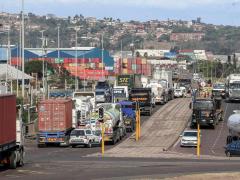
Off-street truck holding capacity was the most urgent priority for road freight operators using congested routes such as Bayhead Road and Solomon Mahlangu Drive, he said.
“From the perspective of a road freight operator, truck-staging facilities are the single most urgent intervention, coupled with a flowing container movement process,” Kelly added.
“Each and every day, trucks queue on Bayhead Road, Solomon Mahlangu Drive and surrounding routes simply because there is no dedicated off-street holding area synchronised with port and terminal booking systems.”
Both organisations welcomed the strategy’s recognition that road expansion alone could not resolve Durban’s logistics bottlenecks, as well as its proposed alignment with the Transnet Rail Infrastructure Management programme, Sanral’s N2/N3 upgrades, the Bayhead Road upgrade and the second port access project.
However, industry leaders raised concerns about implementation, particularly the absence of firm funding commitments and execution timelines.
Recommendations that remained subject to future funding allocations risked leaving the strategy without implementation, Kelly said.
“The strategy concludes with recommendations ‘subject to the availability of funding’ and requires future budget allocations to be separately motivated; this is a real risk that the strategy document becomes a ‘shelf’ document with no prospect of implementation,” he said.
Clear institutional accountability across the public entities involved in Durban’s freight system would also be critical, Safla said.
“The respective responsibilities of eThekwini Traffic Authority, Transnet National Ports Authority, Transnet Port Terminals, Transnet Freight Rail, Sanral, provincial authorities and SARS must be defined, with a named lead and escalation process for each intervention,” McDonald and Logan said.
“A strategy that remains subject to unspecified future funding cannot provide the certainty required by cargo owners and logistics operators.”
The RFA also called for consistent compliance enforcement on municipal freight corridors and said driver welfare facilities, including ablutions, rest areas and security, should be incorporated into truck-staging sites to reduce informal parking in residential areas.
Both organisations called for clearing agents, freight forwarders and road transport operators to be formally included in stakeholder consultations before the strategy was finalised.
“Success should be measured by safer communities, more reliable end-to-end cargo movement and a more competitive Port of Durban – not simply by the publication of another strategy,” McDonald and Logan said.